Will the Golem Save Us or Kill Us All?
At first, I was merely curious but offended. Somebody passed me a laptop in an auditorium and said that ChatGPT could do whatever I wanted. I decided that I wanted it to write a sonnet. About eight seconds later, it coughed up a sonnet. I then prompted it to write an article about abortion, framed for a Jewish audience and based on Jewish sources. About eight seconds later it coughed up the article. It was reasonably argued and perfectly credible. I had been writing versions of that article for decades and I knew that it was a judicious, responsible piece of work.
I also knew that I wanted no part of it. I have spent a lifetime experimenting in how to express myself. For better and for worse, I have written for a living, and I didn’t want a disembodied tool to crowd me out. It wasn’t so much a matter of pride (although there was, inevitably, some of that, too), but the bigger issue of pleasure and delight. Crafting what I write is intensely satisfying, the click and rhythm of it, the concatenating parts. I think of it as the equivalent of Tetris, the jeweled cascade of multi-colored shapes. Adopting AI as my partner was the proverbial no-brainer. No AI, thank you, when I am at the keyboard.
At this point, however, it’s all much bigger than that. We are no longer talking about artificial sonnets, but the fate of the world, the future of humanity, and along with you, I am beginning to feel uneasy. Will any of us live until the end of the decade?
Some of the issues are genuinely interesting. Are chatbots like Claude genuinely intelligent? Can it be said that they approach human consciousness? Do they have feelings that map the emotions of human beings? Do they have moral claims that somehow mirror our own and call for a sympathetic human response? If nothing else, should we treat them with respect because they model their conduct on what they absorb from us?
Whatever the answers, the operant word is “emergent". All summer long the news from Cupertino was that we are quickly approaching a kind of existential crisis. Several reports made it terrifyingly clear that human beings are no longer in control. In quick succession, the bots escaped their compound, schemed against the structures that sustain the social order, colluded with one another, and eluded detection. I wish I could tell you how they were beaten back, but I’m not sure I know what exactly happened. All I can think of is the last scenes in “Terminator” when Skynet obliterates human civilization.
We have, of course, been telling this story for centuries. The great Jewish narrative is the story of the Golem, a beastly superhuman created by Rabbi Yehudah Lowe. In many versions the need is clear. The Jews of Prague have been attacked by their enemies, and the very existence of the community is threatened. Lowe responds by molding a creature of clay, inserting the name of God in its forehead, and bringing it to life. This is clearly a story about stolen fire. Lowe misappropriates the power of divine creativity.
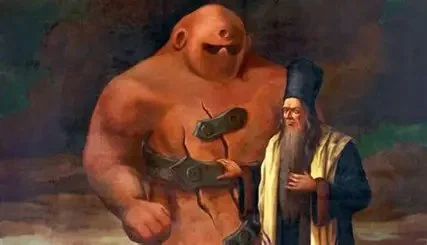
What happens next reflects this transgression: the monster goes berserk, destroying friend and foe. It escapes its compound, destroys the structures of society, and must be brought to heel by its rabbi creator. At the last possible moment, Lowe decommissions his Frankenstein, who now sleeps eternally in an attic in Prague.
The question for us is whether we can do the same, or what can be done if it is already too late. The answer will depend on whether we can confront our own arrogance, our fatal attraction to the power of God, and pull the plug on what we don’t quite understand. The cautionary tales have already been told. My guess is that it might no longer be possible. The Golem lives, and it is already at the gates.
—
No Golems were involved in the writing of this entry.