Unexpected Beauty: The Christmas Card
For several years, I have been collecting vernacular photographs, part of the ocean of images produced by citizen photographers, some dating back to the beginning of the last century. Many of them are from our family and friends. Others were gifted to me or purchased at flea markets and auctions. I believe in the value of this visual experience and I try to write seriously about the images that hold my eye. The new acquisition below came to me this September. Precisely speaking, it is not a vernacular photo, but an image produced by a photographic professional. At the same time, it circulated in the same cultural space, an image handed from one person to the next.
—
One of the great themes of art in the Western world is the shift away from images of faith. It happens at different times and in different places, but artists slowly put aside the preoccupations of the Church and begin to frame out different visions of the world. When Durer shows us a clod of earth in the 1500s, teeming with a variety of plants and grasses, we have left one world and entered another.
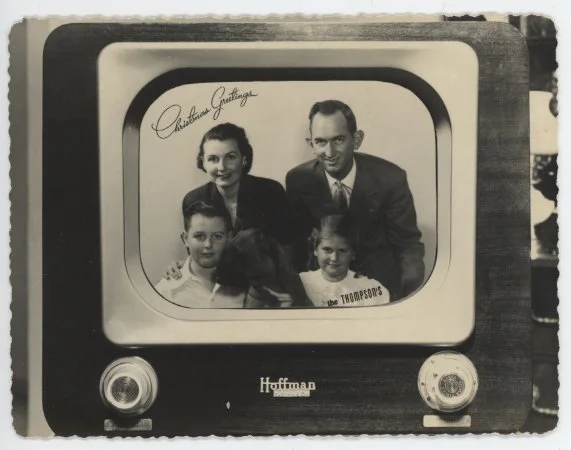
The card pictured here is not a masterpiece. It is not a signpost in the unfolding of art history. You would be right to suggest that I give you a break and take back even the suggestion of an overblown claim. But despite it’s low-brow origins and purpose, it has its own pop-culture significance. These are the Thompsons, spelled with an apostrophe, post-war Americans beaming at us through the frame of a television. Only Thompson, Jr. meets our gaze. The others stare out into the middle distance, heads turned slightly to the right. They are modestly dressed, but carefully combed, compliant with the instructions of the unseen photographer. Only Fido breaks ranks with expectation, and may help us to account for the misalignment of Thompson, Jr.
This is not, of course, a citizen snapshot, but a carefully constructed photographic moment, assembled into final form by a technician. The occasion is Christmas in the early Fifties, based on the hairstyles and the garments of the subjects, but even more certainly by the iconography of the television. The set is a product of Hoffman Radio and Television which enjoyed explosive growth beginning in 1948. Their sets had a reputation for excellent components and high quality engineering in the way they were assembled. In the Western U.S. they were the dominant manufacturer and moved steadily in the direction of color broadcasting. What we are looking at here is an aspirational image. We know nothing about the material wealth of this family, but they are framed out by an early Hoffman television, with the implication that they could afford the best. It’s like an important personage decked out in an ermine collar. The Thompsons what us to know that they had made it.
What’s interesting to me is what is not in this image. The traditional gracenotes of Christmas in America are entirely absent from the Thompson’s greeting card. There is no tree, no holly berries, no cluster of presents. There is certainly no reference to the religious themes of the holiday. You might reasonably ask where is the creche, the Holy Mother? Where is the figure of Baby Jesus? Perhaps because the Thompsons are West Coast Americans, even the seasonal accompaniments—snow, ice, evergreens—are missing from this deeply secularized arrangement. We are looking at a Christmas card stripped clean of Christmas, without a single reference to religious practice or identity. Clearly, this product takes us on a secular trajectory.
That is not a criticism, but a note about art and culture. The same thing happened in a world more familiar to me in the way Jewish greeting cards changed over the decades. They are once again more conventionally religious in the present, but the recent past was marked by the same stripping away. Young couples in motor cars zip into the future, unencumbered by the appurtenances of traditional religion.
The Thompson card is still more interesting because of what it says about modern life and technology. It somehow hints at a world to come when life itself plays out on screens, when we are entangled within a webwork of projected images. The Thompsons invite us to observe them on television, where they live with Fido in the broadcast ether. We are looking at an image of a family within an image, removed from the dimensionality of “real” life. It’s as if they are already occupying a space in the future, where all of life has been flattened and dematerialized.
—
No robots here; just a human author, trying to make sense of the world. AI may be very good for some things, but it runs against the grain for me.