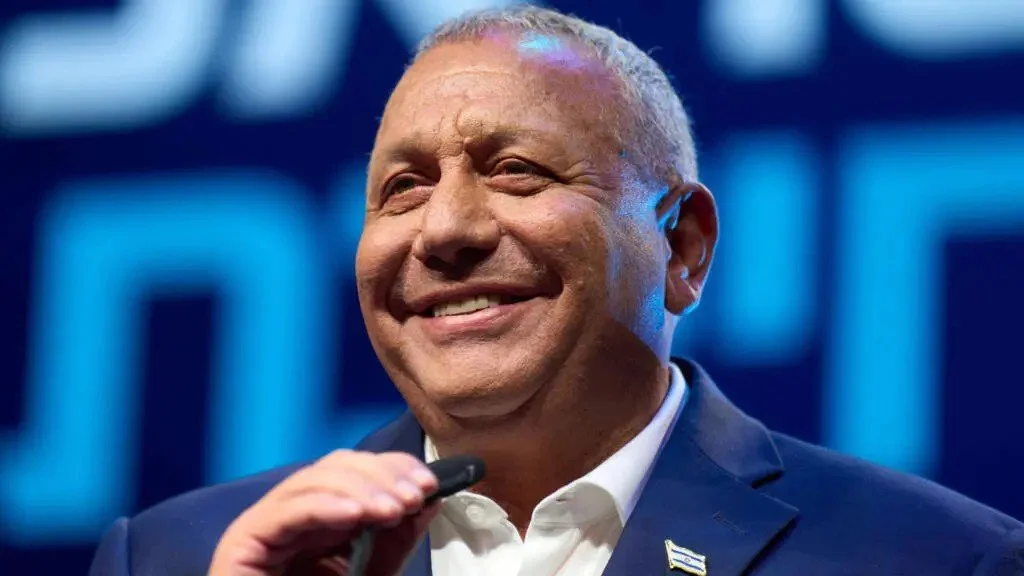
Gadi Eisenkot, Israel’s likely next Prime Minister, is a square, stolid, reassuring man. He has none of the slipperiness of Benjamin Netanyahu, but none of his smoothness or public charisma. He’s slow on his feet with rudimentary language skills, and he is unlikely to pal around with American lawmakers. Those who do will not be charmed either by verve or wit or sly intelligence. That belongs to Netanyahu, not Eisenkot. If he were a character written by Isaac Bashevis Singer, he would have been called Gronem Ox, Singer’s name of choice for heavy-footed characters who still harbor a measure of wisdom and authority.
Eisenkot also trails a cloak of sadness. His son, Gal Meir, was killed in Gaza, one of 973 casualties to date in Israel’s struggle against Hamas. The same for his nephews, Maor Cohen Eisenkot (19) and Yogev Pazy (22). They were the two sons of his sister, Sharon. Meanwhile, Netanyahu’s son, the entitled Yair, was safely installed in a condominium in Miami, the treasured darling of Bibi and Sara. I don’t think that it was a case of bone spurs, but rather the privilege that comes of being the child of a Prime Minister who asks sacrifice of every other Jewish father but withholds his own from the possibility of injury. I say that as the father of two American Jewish children who were also safe from the terror of Gaza. Every family makes its choices.
Gadi Eisenkot must now make other choices. Only once in the short history of the Jewish State have Arab legislators been part of a ruling coalition. That was back in 2021 in the short-lived tenure of Naftali Bennett. The complexities of such an arrangement are understood by everyone. The State of Israel is supposed to be both democratic and Jewish, but there is a long-standing aversion to enfranchising Arabs. You might feel the burden of that history, too. The Land of Israel has been the home of two cultures who have occasionally tendered exclusivist claims. Much of the Arab world signed on to the Muslim Brotherhood Manifesto (1991) which makes no room for Jews in its vision of Palestine. In fact, it calls for wholesale slaughter. Some Jews have come perilously close to the same, although they represent an extremist sliver of the electorate. At the same time, there is no sympathy for a two-state solution and very little sympathy for the residents of Gaza.
Netanyahu has already said no to ruling with Arabs, which means that he will never reach a governing majority. The magic number is 61, half-plus-one of the full number in the Israeli Parliament. Netanyahu is barely at 53. Eisenkot has said that he might consider it, but that the Palestinian parties would have to renounce Hamas and do several other things to qualify themselves as partners. One of the Arab parties is closer than the other, but both are reluctant to go out on that limb. It would mean an existential risk.
But Eisenkot seems to be preparing for something quite unusual. He has termed the template for his plan an “emergency government,” which opens the way for unprecedented partnership. It acknowledges the gains of the Arab parties. Instead of a piddling number of seats in the Knesset, they now control an extraordinary share. Nineteen seats would give Eisenkot his coalition. I give him credit for acknowledging a new reality: manifesto or not, Arab parties are participating in a system they have always described as inherently racist and contaminated. Their turn toward politics and away from armed conflict may be real or bogus or something in between. I choose to believe that it is an incremental gain, and it is something that will stabilize Israel’s situation.
The question is whether Eisenkot can get us there. His tenure, if he achieves it, will likely not be revolutionary. The standing consensus is that Palestinian statehood is unacceptable. No mainstream Jewish party is currently behind it. The same for radical compromise on the West Bank. This goes for Yashar, the party of Gadi Eisenkot, who participates in the overwhelming consensus.
But this is really the time for fractional progress. A government which brings Jews together with a meaningful number of Arab-Israeli citizens would force issues—and compromises—that have been unthinkable until now. That’s what happens when you sit down in a cafeteria and share a plate of chummus with your fellow legislator. That’s not an invitation to Sunday brunch. It certainly isn’t peace in our time. It is the managerial politics of longtime antagonists, and it is a cause I hope Gadi Eisenkot will embrace.