I would watch Olivia Colman eat toast and eggs. Gladly. Raptly. Like it was a privilege. She was a masterful middle-aged Elizabeth in The Crown and starred with Benedict Cumberbatch in the remake of The Roses. She has a knack for playing opposite good-looking men where her plainer looks make her not a whit less powerful.
It’s the way her face registers complex emotion, the tears that fight for primacy against laughter. Her mouth functions like a separate character, protruding slightly from the rest of her face. She doesn’t have quite the same pedigree as the crop of grandes dames to whom she is often compared. As a television actor who transitioned to film, she first played no classic roles in British regional theater. But it never seems to get in the way. Her voice and gestural language are beautiful to hear and watch.
All of this is on full display in the recently released Wicker with Alexander Skarsgard, yet another male beauty who is overmatched by Colman. The script, based on a short story by Ursula Wills-Jones, tells the story of a not-so-simple fisherwoman (Colman) who is treated roughly in a medieval town. It’s not so much set in a real landscape, but the fairy tale world of the Brothers Grimm. Colman’s character demands that a gifted basket maker fashion her a husband out of woven willow. The result is a masterpiece (Skarsgard in prosthetics), who turns the wives of the village inside out. Compared to their husbands he is courtly and considerate. He is also, needless to say, fiendishly handsome.
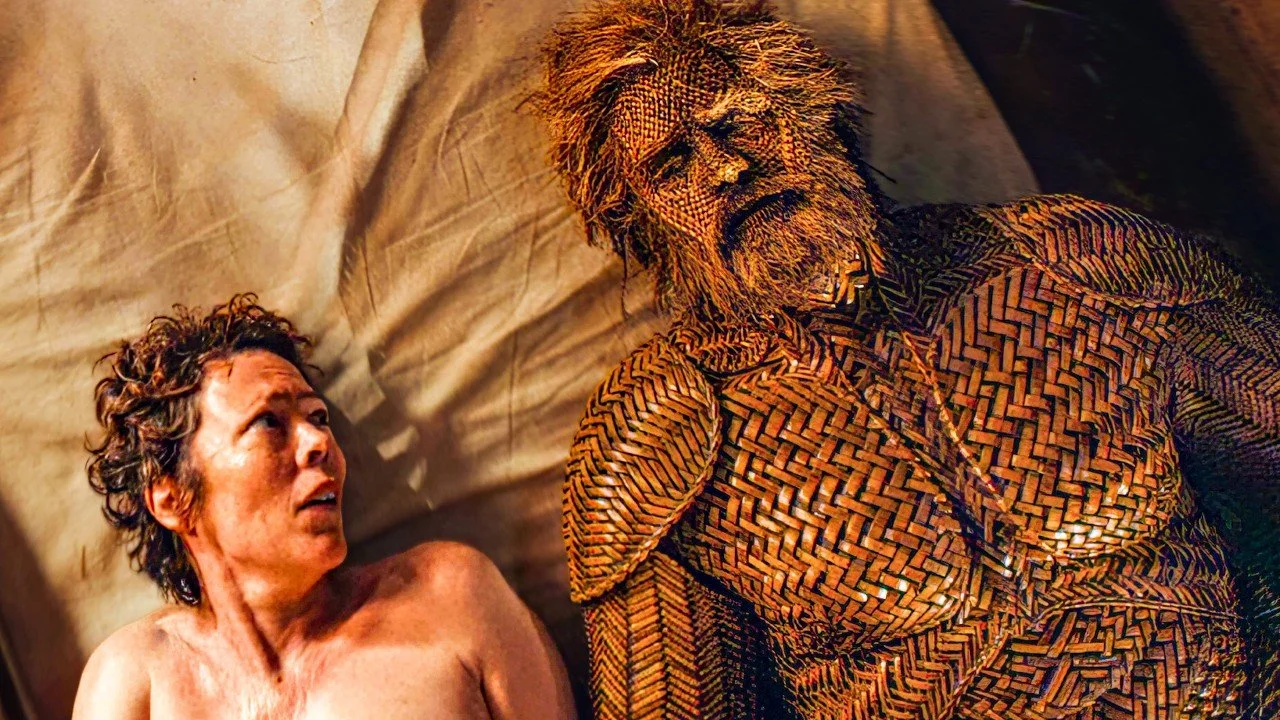
Skarsgard is limited by what is pasted to his face and the strange and airy lightness of his speaking voice. Colman works with no such limitations. She gruffly informs the basket maker of what she wants and then can’t quite decide whether to remain or go. The transitory conflict plays out on her lips which seem ready to speak until she is undone by hesitation. Turning away, she simply grunts, as if to seal their contract by pounding a gobbet of wax. It’s a simple, masterful, economical gesture.
The story itself is a kind of pastiche, made up of spare parts from European folklore. There is the gifted wee person in the form of Peter Dinklage who performs the role of Rumpelstiltskin. A dangerous young matron bewitches her village in an enchanting performance of sympathy and hauteur. She could be one of Agnon’s ladies of the forest. Pinocchio’s wooden nose grows by dint of lying, while the wicker man’s appendage grows when he is aroused. You can feel the presence of elements you know, plucked from the ether of centuries of storytelling.
But what’s most powerfully at work is another important theme: the automaton, or puppet, who comes thrillingly to life and unsettles the order of human society. Just as Geppetto brings Pinocchio to life, the basket maker does the same for the fisherwoman, summoning Alexander Skarsgard out of a bundle of willow, weaving his creaking penis out of straw. We have seen this story in the tale of the Golem, the gothic romance of Frankenstein, the fairytale Hugo by filmmaker Martin Scorsese. But unlike many of them, Wicker is more benign. Skarsgard does not rampage through the village but unsettles the established order by his tenderness, for which there is no fix but his own departure. In the last scene of the film, the three principals—basket maker, fisherwoman, and wicker man—are in a rolling wagon, heading away from the village with a new wicker baby.
Yet despite the cautionary nature of the film—technology can be more than any of us can bear—the view of Wicker is unusually optimistic and not quite aligned with the current zeitgeist. Whatever we make, be it puppets or AI, it can be harnessed to deepen and enrich human life. That feels like a fairy tale ending to me.